Economix just got its first review! A good one! From Bob Greenberger!
This is a good day.
|
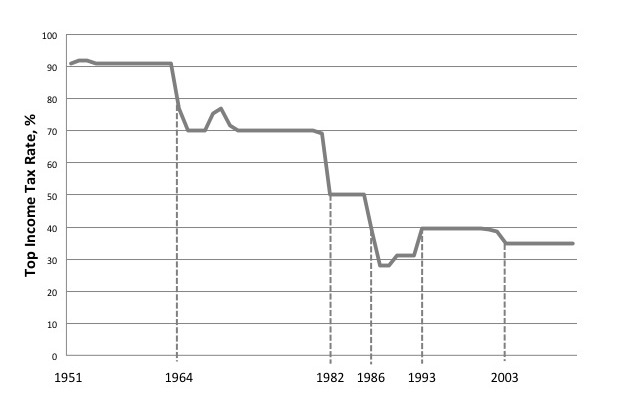
Economix just got its first review! A good one! From Bob Greenberger! This is a good day. We’re constantly hearing about how rich people are wealth creators, job creators, the most productive members of our society, a bunch of Hank Reardons, bla bla bla ad infinitum, and how we should cut their taxes so that they can unleash their productive powers. The more intelligent-sounding purveyors of this point of view use sophisticated economic models to support their claims. But models are just that—they’re models of what should happen, given certain assumptions. And the real world is far more complex than any model can portray. The real way to understand what cutting taxes on the rich would do is: try it and see what happens. But I don’t recommend doing that. Why not? Because we already freaking did it. Many times. We know what happens when we cut taxes on the rich; we just choose not to remember. Thing is, back in the 1950s and 1960s, taxes on the rich were very high. Past a certain point, the government took almost all of your additional income—as much as 92 cents on the dollar. Yes, there were deductions; nobody paid 92% of their income. But a rich person deciding whether or not to earn an extra dollar had presumably already found all the deductions he could, so he really was faced with the prospect of working harder in order to earn only a few more cents. So back then when rich people said, hey, we would work harder and create more wealth if we were allowed to keep more of the reward, they were making a plausible argument. In fact, it was so plausible that we believed them and cut taxes. First to 70%, and then way below that. Meanwhile, we accepted higher taxes for ourselves and fewer services from government. So what happened? Here’s the maximum tax rate—the tax paid on income in the highest tax bracket—over time. Note the big cuts in 1964 and in the 1980s, followed by Clinton’s 1993 tax increase, followed by Bush’s cuts.
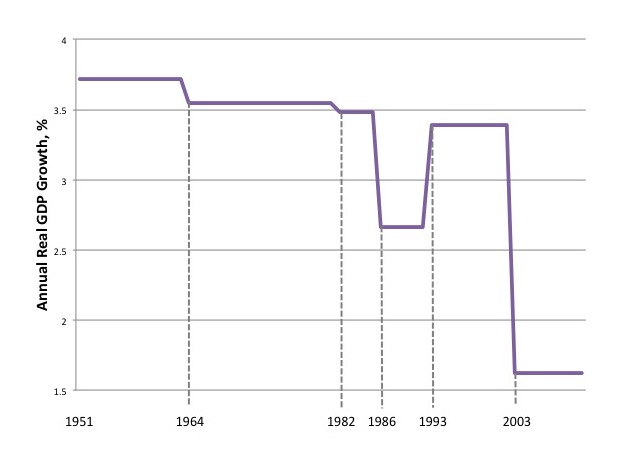
Now: If low taxes on the rich do what conservatives say, GDP should have been higher when the top tax rate was low, and lower when it was high and job creators were oppressed. So here’s economic growth by year, courtesy of the Bureau of Economic Analysis.
Huh? All that up and down is hard to track. So let’s average economic growth over the relevant periods, which are:
Here’s what the averages look like.
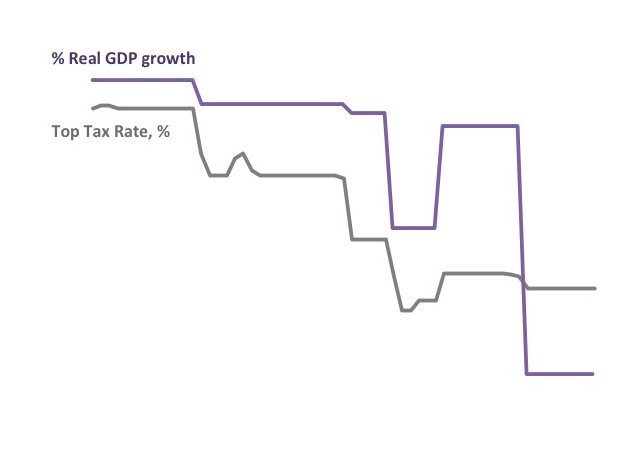
Just to make things clearer, let’s put both lines together (ignoring the scale—we’re just looking at the pattern, not the absolute number):
Well, hell. So low taxes for the rich haven’t been good for the economy. The association goes almost exactly the opposite way. And still the rich say that cutting their taxes will unleash their dormant productive powers. But if it hasn’t happened yet, it’s not going to happen. The only thing we can conclude is that rich people give themselves too much credit. Now: You can play around with the exact periods you choose to average the data over, but the overall pattern will hold. For instance, if you say that we should exclude the current economic mess (everything after 2006, say) because its causes are clearly much bigger than just the Bush tax cut, we get this, which is even more exact:
Heck, just to show I’m not cheating, here’s every data point since 1951 (the line was drawn by Excel, not me):
[EDIT: I used Excel to get the correlation coefficient of that (0.21), transformed that into a t, and then got the p value of the t, which is apparently legit. The p value I got, assuming I did all the math correctly (it’s entirely possible that I didn’t) was 0.096 (which matches my eyeballing, more or less). That’s means that the observed correlation (high taxes are correlated with high growth) could have been just statistical noise, but there’s roughly a 9 in 10 chance that it wasn’t and that high taxes are really connected in some way with high growth. This is what statisticians call a “trend,” which is statspeak for, yeah it tends that way but you haven’t really shown anything. You need a 19 in 20 chance before a statistician will accept it as proof. [EDIT of the edit: Not “proof” exactly, as Reddit user Konchshell points out–rather, worthy of notice.]] Other people have cut the data in different ways and gotten the same result. They shy away from concluding that tax increases help the economy, and they’re right: none of this proves that tax cuts for the rich are bad for the economy, or that high taxes are good—there may have been other factors (like oil prices) that were more important. For that matter, it’s still possible that rich people really are job creators, and that they create more jobs when they’re motivated, but that high taxes are what motivate them. After all, rich people’s lives are almost all carrots and very few sticks; maybe the occasional blow from a stick will spur them to action more than another truckload of carrots. But all of this is beside the point. The point is that it’s simply impossible to look at the data and honestly think that cutting taxes on the rich will help the economy. [EDIT: user Konchshell on Reddit points out that it’s not in fact impossible, which is true–I’m overstating it. But still] That leaves one thing we can safely predict about taxes on the rich: They will bring in revenue. We could use some revenue right about now. No wonder conservatives always argue about what some model says should happen. The last thing they want is a discussion about what has happened. Gawker.com asked unemployed people to tell their own stories, and the responses have been flooding in. They’re harrowing, but they’re worth reading. Or rather, what makes them harrowing is what makes them worth reading; these are intelligent, articulate people (the all caps rants presumably don’t get published) who, often, didn’t make any particularly bad decisions but are stuck in the shithole for the foreseeable future. As one submitter put it:
Personal stories are important because statistics—so many unemployed for so long bla bla bla—don’t register on our minds in the same way. Think of how many people understand the Holocaust through the experiences of Anne Frank or Vladek Spiegelman. (As someone said, “One death is a tragedy. A million deaths is a statistic.”) Also, all too many of these submitters tell the same story–unemployment insurance helps, but once you’ve been unemployed for too long, employers won’t look at you. That’s even if the long-term unemployment doesn’t drain your confidence, make you screw up interviews, and generally make you unemployable. This is why we should have public works. We’re paying these people to look for work when there is none. We should be paying them to work. It’s really not rocket science: there’s plenty of work to do, and there are people ready and willing to do it. And right now is a great time, because we can borrow at nearly no interest–it’s free money. I’ll end with another quote:
Bill McKibben’s new Rolling Stone article: Global Warming’s Terrifying New Math, is clear and chilling. The article goes into depth, but the math is simple:
And that’s not even the worst thing. The worst thing is:
In McKibben’s words:
So it’s not just a matter of using less. We have to somehow convince ExxonMobil, Saudi Arabia, Venezuela, Shell, Lukoil, and BP to keep most of their oil—their wealth, the livelihoods of their employees and shareholders—in the ground. (And that’s just some of the oil sellers, and that’s just oil). McKibben also makes a point I make in Economix: Don’t look to technology, like geoengineering and whatnot. We have the technology to fix our problems today. But we don’t use it, for political reasons. The solutions—if there are even solutions anymore—are political, not technological.
From Planet of Slums It’ll be no surprise to my regular readers that I’m a bit skeptical when people praise “the market” (by which is usually meant “powerful companies that do not operate in anything resembling a real free market”), but there is a case when leaving things to private business is clearly better than leaving it to government: When an issue has become so gummed up with politics that a simple profit-and-loss approach can cut through the bullshit. An example: The drug Accutane is (was?) an acne drug (so it was taken by teens) and it caused horrific birth defects. Faced with the problem of keeping teens not pregnant, the drug company (Roche) created a pregnancy prevention program for girls and women taking the drug. I bring it up because I worked on it and it was admirable—clear, correct information presented frankly, with barely a mention of abstinence. After all, Roche had no incentive to screw around; every baby born with Accutane birth defects was bad press for the drug. And the program was successful: There were very few pregnancies among Accutane patients. This is pretty definitive proof (if more proof were needed) that the government’s politically motivated “abstinence-only” sex education is wrongheaded: When a private company’s profits depended on preventing pregnancy, they didn’t waste their time talking about abstinence. The market spoke, and in this instance (because the company had the right incentives), the market was right. That’s the thing, though: the market is only worth listening to when its incentives are right—when companies are being paid to honestly evaluate what we want to know. Now let’s look at hydrofracking. Blindly relying on the market won’t help here, of course: fracking companies are paid if we say yes to fracking, which means they’ll say it’s safe whether or not it really is. But what about insurers? Insurers have the right incentives: when they insure frackers, they make money if the process turns out to be safe, and they lose money if frackers wind up having to pay for poisoned wells and sick babies. So this news is important: Nationwide, one of the country’s biggest insurers, has decided that it won’t even try to insure frackers. In the company’s own words:
If fracking was as risk-free as its advocates say, Nationwide would be rushing to insure frackers. It’s rushing in the opposite direction. The market has just spoken about the risks of hydrofracking. They’re very real. From yesterday’s New York Times:
Spot on.
The book exists! I have an actual, physical copy in my hands! You can pre-order it on Amazon! That is all. Came across this quote, from Rexford Tugwell:
Tugwell was one of FDR’s “brain trust”; he was speaking of the depression of the 1930s, but he could have been speaking about today. Quoted in William Manchester, The Glory and the Dream, p451. Manchester adds, “To save the country by saving the banks, he [Tugwell] added, was like trying to revive a dying tree ‘by applying fertilizer to its branches instead of to its roots.’”
Our quote of the day comes from Alexis de Tocqueville:
Quoted in Henry George, Progress and Poverty.
|

Buy the book:
| |



 .
.